Tech
Know What’s Going Into Your Board
Base Materials
Crown Plastics and Iso-Sport make plastic base material for most snowboards on the market today. Does “sintered base”, “ptex”, or UHMWPE ring a bell? What about all the grades like “sintered 2001″, “sintered 4001″, etc? They are all the exact same thing: Plastic Polyethylene sheet formed through a process called Sintering. Basically, Polyethylene beads or powder are loaded into a bin, run into a huge machine, and smashed in a mold. The heat and energy generated from the pressure and impact melt the beads in such a way that the result is sheet-form of Ultra High Molecular Weight Polyethylene, or UHMWPE. Both companies have the ability to create huge rolls of this stuff with rediculous machines. 2001, 4001, etc are grades of this base material where additives are placed into the mix. For more info visit www.crownplastics.com or www.isosport.com
Ever Hear of “Extruded Base”? Same plastic, different forming process, different result in properties. Extruded base is created by pouring the beads into an Extruder machine. These are usually “screw extruders”, where the beads are forced down a chamber by a large screw-thread. The forces the screw threads generate onto the beads cause the beads to melt while travelling along the path. At the end of the chamber is a die, basically a cutout of the cross section of the shape, more or less a slot. The melted plastic is forced through the die and cooled, taking on the shape of the die, and in our case, coming out as a sheet. This is good, hard plastic, but sintered UHMWPE is just that much better. UHMWPE has a lower coefficient of friction and higher strength than extruded base. Extruded is cheaper to buy in bulk, so you might find it on some beginner boards, or those popular Made in China decks you find in your sporting goods store or Wal-Mart. Basically, almost every USA hand made snowboard has a UHMWPE base, unless its got a beer company logo on it or some shit.
Edges
“Our edges are Rockwell 48 hardened steel, the best!” Haha dont fall for that bullshit. Rockwell doesnt do anything to your edge. Rockwell comes from “the Rockwell Hardness Scale”. 48 is a number for how hard the steel is. It is carbon steel, heat treated a certain way to get it near 48 on a Rockwell tester. Almost everyone has the same carbon steel edges, some have stainless steel, or brass, and those will be different numbers on the rockwell scale. Whatever the case, almost all edges come from one of two companies in either Germany or Austria.
“VDS” Dampening Strips and Dampening
“Vibration Dampening System” Is what this means if I remember correctly. More bullshit. It’s rubber. Companies lay these rubber strips all over the laminate matrix (whoa I said matrix!) of their boards, but it provides minimal and localized dampening. What it DOES do, however, is improve bonding between the metal edge and the fiberglass, reducing delamination about the edge. We lay narrow strips directly over the edge during the laminating process and soak it with resin. This improves the bond between the steel edge and the fiberglass. Its sole purpose in a Blak Sheep board is to improve bonding for a higher quality snowboard.
The true dampening comes from the properties of the epoxy resin we use to cure the board. Your entire Blak Sheep snowboard is dampened. Some companies are using a slightly thicker rubber strip and placing “half moons” of it in the nose and tail area, and have recorded results of reduced vibration. Some ski manufacturers put these thicker strips all over. Why not just add it to the resin, then it goes everywhere? This allows a board with lots of pop to return to rest more efficiently. Blak Sheep boards are loaded with thousands of tiny shock absorbers, allowing you to rip corners without skidding out, stomp that landing, and have a flexy board that doesnt wobble or flap like a birdy.
fiberglass
“22oz triax”, “19oz triax”, “19oz biax”, there’s even “quadrax” now. “22 oz” is its weight per square yard. Therefore 19oz is lighter, and sligtly thinner fibers. Triax means the weave goes in three directions, usually 45, 45, and 0 degrees, with 0degrees being the longitudinal direction. Biax is either 45 45, or 0 90. There are one or two other biax configurations but they’re far less common.
Wood Cores
We are currently in the testing phase of our woodcores. We are working on three different types.
1) Vertically laminated Poplar. Poplar is strong and a good choice for park. It is a medium weight.
2) Vertically laminated Aspen. Poplar is stronger but Aspen is lighter and more lively.
3) The New Jersey Hard Core: currently under development. Full length strips with no joints. Strips are glued together with a top-secret adhesive that has yet to hit the market. This core is currently a combination of Poplar for strength, and Birch for weight savings. The core also features additional “double-wide-walls”: a strip of Birch or Poplar on each side curved to the sidecut of the core. These strips encapsulate the other strips of the core. As a traditionally laminated core is cut to shape, the strips along the sidecut portion get cut off, and near the contact points, or “corners”, you end up with short narrow pieces which are weak spots in the board. Having these all encapsulated in a curved outer strip greatly increases strength, reduces core failures, and increases sidewall impact strength.
Sidewalls
Our first few boards we built contained UHMWPE or “P-TEX” sidewalls. These work great. But our new 2010 boards now contain bamboo sidewalls. Bamboo is considered a “renewable resource” because of how easily it grows. It is surprisingly impact resistant, much like that of P-TEX. It also bonds way better to the other layers, and looks pretty darn cool on your board.
Inserts
Most binding inserts are manufactured in China. We located a USA binding insert factory, and we use them. It costs us more money but its important to us that NOT ONE COMPONENT OF OUR SNOWBOARDS IS MADE IN CHINA. These inserts have the same thread pitch and are actually slightly beefier than chinese ones.
Additional Reinforcements
Carve-lar: A Blak Sheep exclusive. No, not really, we just decided to name it. Carve-lar is Carbon Fiber and Aramid (Kevlar) weaved together. Aramid is the real name for Kevlar, a certain brand of Aramid. Carbon Fiber adds rigidity and “pop” where applied, Aramid adds bullet-stopping strength. Why not have the best of both worlds? Carve-lar is applied in strips either underneath the core or just above it.
Sublimated Topsheets
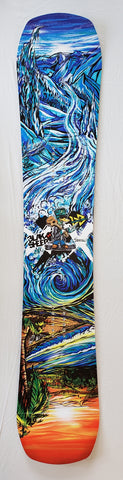
The top and bottom graphics are applied to white material through a process called Dye Sublimation. The graphics are developed on a computer in high resolution, and printed onto transfer paper. This paper is then laid over the sheet and pressed at 400 degrees. The inks turn into gas phase and go INSIDE the materials. Pretty cool and looks awesome!